
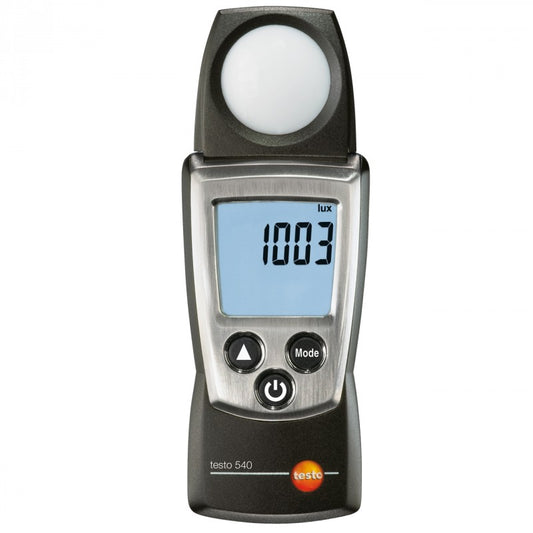
Lux Meters

1 product

LUX Meter for Broad Coverage

The LUX meters from Testo is designed to measure extensive range of applications, involving illumination equipment, lighting work and facility management. This instrument is capable of testing LED lighting and supports a wide range of luminance levels.

LUX is a measurement of the overall intensity if light, within an environment, for any given area or a distance from the source. The measurements by this instrument in an environment are the amount of light perceived by a normal human eye.

A lux meter uses a photocell to capture light. The meter then converts the light to an electrical current. Measuring the current would help calculate the LUX value of the light.

Key features of LUX instruments

  • Complies with the basic standards
  • Flexibility to record measurements from a remote location
  • Saves measured values
  • Compatible with LED lighting
  • Large display

Frequently Asked Questions

Human eyes perceive different colors (wavelengths) with varying sensitivity. A professional Lux meter must be calibrated to the CIE photopic spectral luminous efficiency curve to "see" light exactly as a human does. Without regular professional calibration, the sensor’s filter can degrade, leading to incorrect brightness readings that may fail Australian workplace safety standards.

Many older Lux meters are calibrated specifically for incandescent light. Modern LEDs have different spectral peaks, which can cause measurement errors of up to 10-15%. HK Calibrations ensures your meter is certified for multiple light sources, providing the accurate data needed for energy-efficient lighting upgrades and Australian building compliance.

Under Australian Workplace Health and Safety (WHS) protocols, adequate lighting is mandatory to prevent eye strain and workplace accidents. To ensure your lighting audits are legally defensible, we recommend professional calibration every 12 months. This provides a documented chain of accuracy for safety officers and insurance auditors.

Cosine correction ensures the Lux meter accurately measures light hitting the sensor from various angles, not just directly from above. If the sensor dome is scratched or misaligned, your readings in wide-open spaces like warehouses will be inaccurate. Our calibration process verifies the angular response of your sensor to ensure uniform measurement across the entire site.

Yes. We certify instruments for a wide range of intensities, from low-light emergency exit path testing to high-intensity solar and stadium lighting. Our traceable calibration ensures that whether you are measuring 0.1 lux or 100,000 lux, your device remains linear and accurate across its entire range.

Emergency lighting must meet strict minimum lux levels under Australian Standard AS 2293. If your Lux meter is uncalibrated and overestimates brightness, you could be left with non-compliant safety exits that fail during a power outage. Regular professional certification is the only way to guarantee these life-safety systems meet the required legal thresholds.